Redis源码分析(dict)
源码版本:redis-4.0.1
源码位置:
一、dict 简介
dict (dictionary,字典) 通常采用 Key-Value 形式存储。它通过 Hash 函数 对 Key 求哈希值来确定 Value 的位置,因此也称为哈希表(Hash Table),是一种用于解决算法中 查找问题 的数据结构,默认算法复杂度接近 O(1)。
Redis 全称 REmote DIctionary Server (远程字典服务器),本质上就是一个大字典。它的 Key 通常是 String 类型,而 Value 可以是 String、Set、ZSet、Hash、List 等不同类型。下面我们将深入分析 dict 的数据结构定义。
二、数据结构定义
与 dict 相关的关键数据结构有三个:
dictEntry:表示一个 Key-Value 节点。dictht:表示一个哈希表。dict:Redis 中的字典结构,包含两个dictht。
1. dictEntry 结构
dictEntry 结构的代码如下:
typedef struct dictEntry {
    void *key;                // key,void* 表示任意类型指针

    union {                   // 联合体,对于数字类型提供了专门的类型优化
       void      *val;
       uint64_t  u64;
       int64_t   s64;
    } v;

    struct dictEntry *next;   // next 指针,用于解决哈希冲突

} dictEntry;
2. dictht 结构
dictht 的代码如下:
typedef struct dictht {
    dictEntry **table;        // 数组指针,每个元素都是一个指向 dictEntry 的指针

    unsigned long size;       // 表示这个 dictht 已经分配空间的大小,大小总是 2^n

    unsigned long sizemask;   // sizemask = size - 1; 是用来求 hash 值的掩码,为 2^n-1

    unsigned long used;       // 目前已有的元素数量
} dictht;
3. dict 结构
最后是真正的 dict 结构:
typedef struct dict {
    dictType *type;     // type 中定义了对于 Hash 表的操作函数,比如 Hash 函数,key 比较函数等

    void *privdata;      // privdata 是可以传递给 dict 的私有数据

    dictht ht[2];       // 每一个 dict 都包含两个 dictht,一个用于 rehash

    int rehashidx;      // 表示此时是否在进行 rehash 操作

    int iterators;      // 迭代器
} dict;
通过上述三个数据结构,可以大致看出 dict 的组成:数据(Key-Value)存储在每一个 dictEntry 节点;一个哈希表就是一个 dictht 结构,里面标明了 Hash 表的 size、used 等信息;每一个 Redis 的 dict 结构默认包含两个 dictht。
如果有一个哈希表满足特定条件需要扩容,则会申请另一个哈希表,然后把元素 ReHash 过来。ReHash 的意思是重新计算每个 Key 的 Hash 值,然后把它存放在第二个哈希表合适的位置。这个操作在 Redis 中并不是集中式一次完成的,而是在后续的 增删改查 过程中逐步完成的,这叫渐进式 ReHash,后文会专门讨论。
三、创建、插入、键冲突、扩张
下面我们跟随一个例子来看有关 dict 的创建、插入、键冲突的解决办法以及扩张的问题。
调试建议:下载一份 Redis 源码,直接把server.c中main函数注释掉,加入自己的代码,直接make之后就可以运行调试。
我们的测试代码如下所示:
int main(int argc, char **argv) {

    int ret;
    sds key = sdsnew("key");
    sds val = sdsnew("val");
    dict *dd = dictCreate(&keyptrDictType, NULL);

    printf("Add elements to dict\n");
    for (int i = 0; i < 6 ; ++i) {
        ret = dictAdd(dd, sdscatprintf(key, "%d", i), sdscatprintf(val, "%d", i));
        printf("Add ret%d is :%d ,", i, ret);
        printf("ht[0].used :%lu, ht[0].size :%lu, "
                       "ht[1].used :%lu, ht[1].size :%lu\n", dd->ht[0].used, dd->ht[0].size, dd->ht[1].used, dd->ht[1].size);
    }

    printf("\nDel elements to dict\n");
    for (int i = 0; i < 6 ; ++i) {
        ret = dictDelete(dd, sdscatprintf(key, "%d", i));
        printf("Del ret%d is :%d ,", i, ret);
        printf("ht[0].used :%lu, ht[0].size :%lu, "
                       "ht[1].used :%lu, ht[1].size :%lu\n", dd->ht[0].used, dd->ht[0].size, dd->ht[1].used, dd->ht[1].size);
    }

    sdsfree(key);
    sdsfree(val);
    dictRelease(dd);

    return 0;
}
程序运行输出如下:
Out >
Add elements to dict
Add ret0 is :0 ,ht[0].used :1, ht[0].size :4, ht[1].used :0, ht[1].size :0
Add ret1 is :0 ,ht[0].used :2, ht[0].size :4, ht[1].used :0, ht[1].size :0
Add ret2 is :0 ,ht[0].used :3, ht[0].size :4, ht[1].used :0, ht[1].size :0
Add ret3 is :0 ,ht[0].used :4, ht[0].size :4, ht[1].used :0, ht[1].size :0
Add ret4 is :0 ,ht[0].used :4, ht[0].size :4, ht[1].used :1, ht[1].size :8
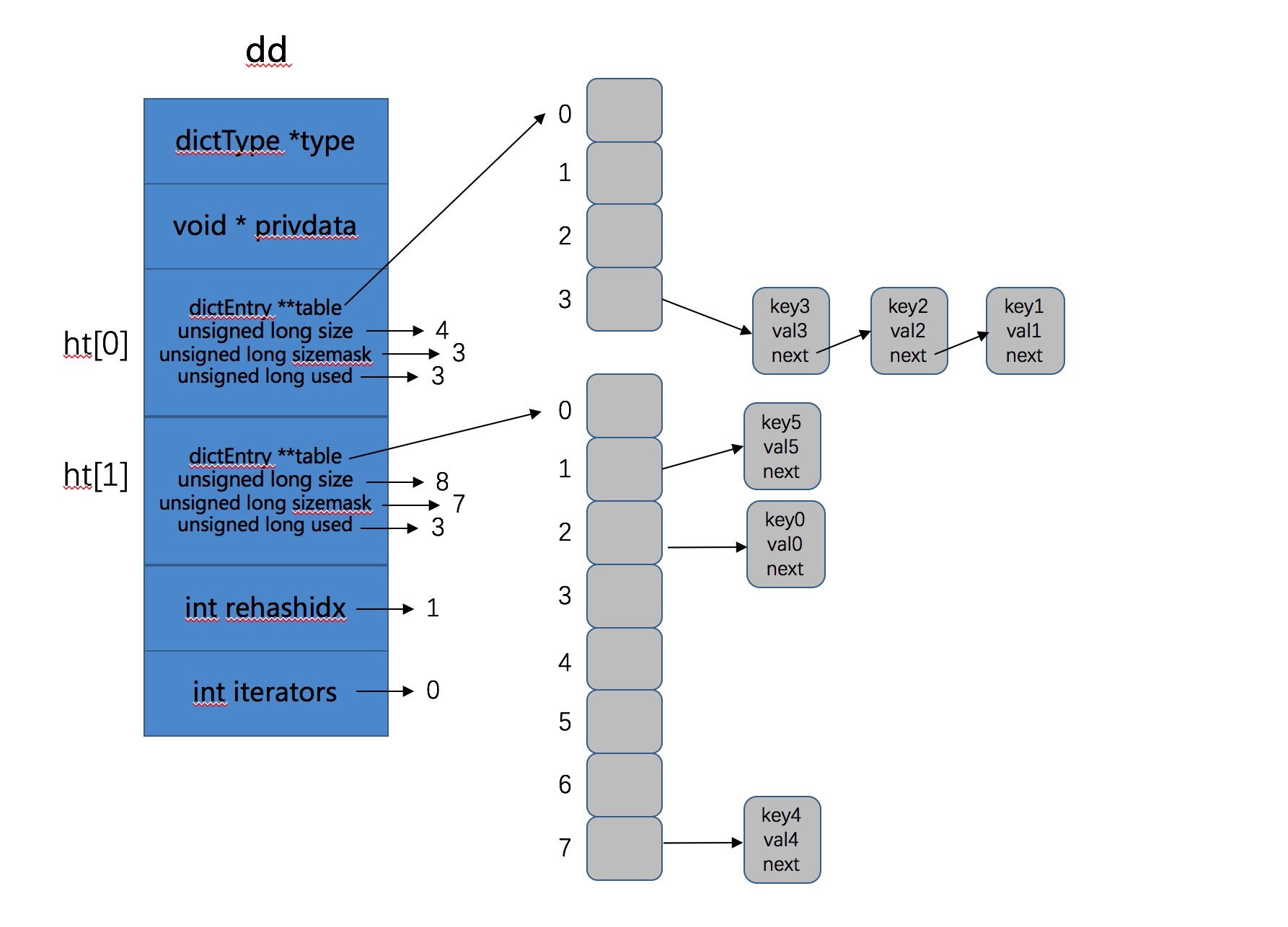
Add ret5 is :0 ,ht[0].used :3, ht[0].size :4, ht[1].used :3, ht[1].size :8

Del elements to dict
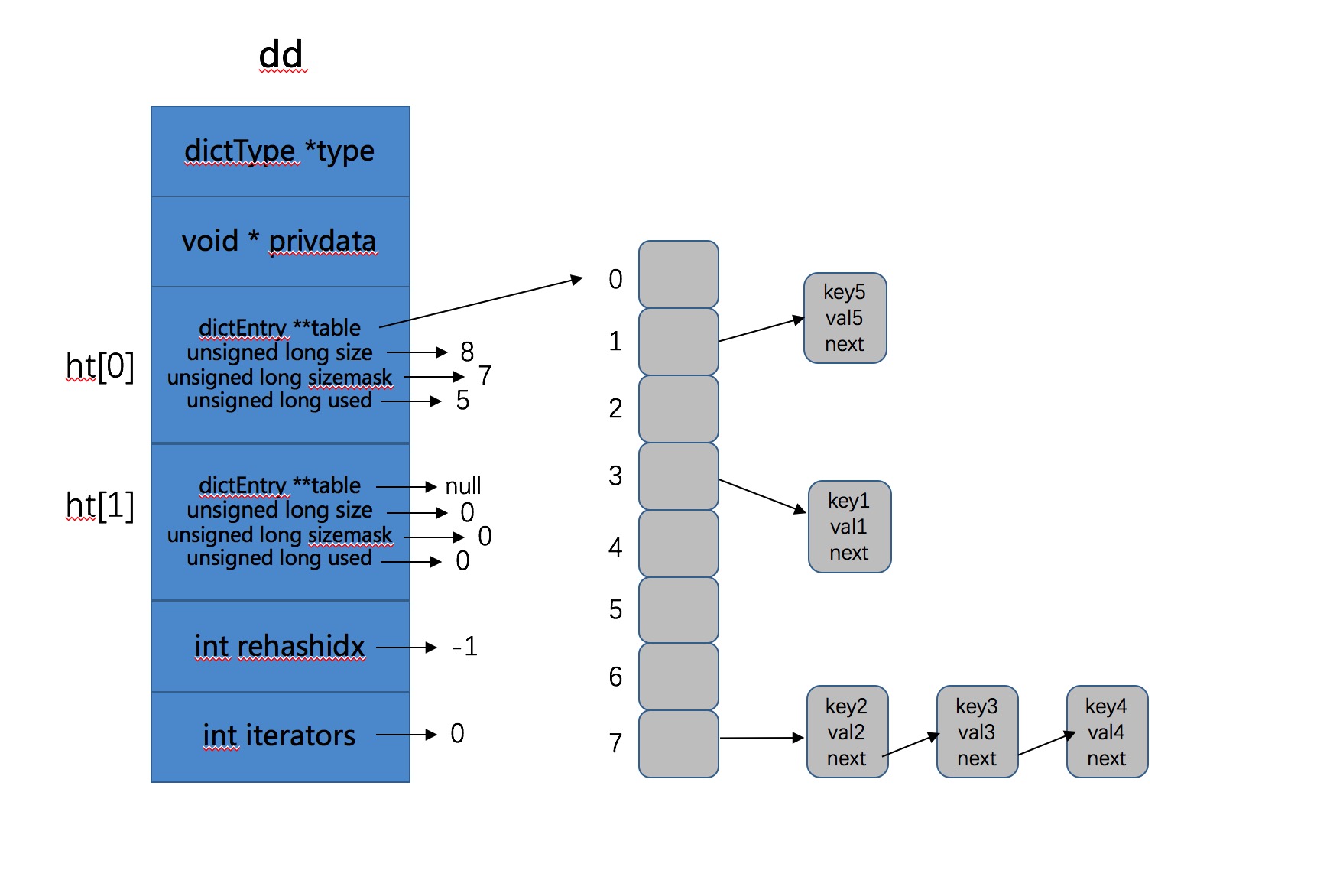
Del ret0 is :0 ,ht[0].used :5, ht[0].size :8, ht[1].used :0, ht[1].size :0
Del ret1 is :0 ,ht[0].used :4, ht[0].size :8, ht[1].used :0, ht[1].size :0
Del ret2 is :0 ,ht[0].used :3, ht[0].size :8, ht[1].used :0, ht[1].size :0
Del ret3 is :0 ,ht[0].used :2, ht[0].size :8, ht[1].used :0, ht[1].size :0
Del ret4 is :0 ,ht[0].used :1, ht[0].size :8, ht[1].used :0, ht[1].size :0
Del ret5 is :0 ,ht[0].used :0, ht[0].size :8, ht[1].used :0, ht[1].size :0
1. 创建字典
dict *dd = dictCreate(&keyptrDictType, NULL);创建了一个名为dd,type 为keyptrDictType的 dict。
创建代码如下,需要注意的是这个操作只给 dict 本身申请了空间,但是像 dict->ht->table 这些数据存储节点并没有分配空间,这些空间是在 dictAdd 的时候才分配的。
/* Create a new hash table */
dict *dictCreate(dictType *type,
        void *privDataPtr)
{
    dict *d = zmalloc(sizeof(*d));    // 申请空间,sizeof(*d) 为 88 个字节

    _dictInit(d,type,privDataPtr);    // 一些置 NULL 操作,type 和 privdata 置为参数指定值
    return d;
}
2. 插入元素
ret = dictAdd(dd, sdscatprintf(key, "%d", i), sdscatprintf(val, "%d", i));接着我们定义了两个sds,并且通过 for 循环分别将他们dictAdd。
来看下 dictAdd 的代码,它实际上调用了 dictAddRaw 函数:
dictEntry *dictAddRaw(dict *d, void *key, dictEntry **existing)
{
    int index;
    dictEntry *entry;
    dictht *ht;

    if (dictIsRehashing(d)) _dictRehashStep(d);

    /* Get the index of the new element, or -1 if
     * the element already exists. */
    if ((index = _dictKeyIndex(d, key, dictHashKey(d,key), existing)) == -1)
        return NULL;

    /* Allocate the memory and store the new entry.
     * Insert the element in top, with the assumption that in a database
     * system it is more likely that recently added entries are accessed
     * more frequently. */
    ht = dictIsRehashing(d) ? &d->ht[1] : &d->ht[0];
    entry = zmalloc(sizeof(*entry));
    entry->next = ht->table[index];
    ht->table[index] = entry;
    ht->used++;

    /* Set the hash entry fields. */
    dictSetKey(d, entry, key);
    return entry;
}
可以看到首先检测是否在进行 ReHash(我们先跳过 ReHash 这个概念),接下来算出了一个 index 值,然后根据是否在进行 ReHash 选择了其中一个 ht(0 或者 1),之后进行了头插。而且英文注释中也写得很清楚:将数据插在头部基于数据库系统总是会经常访问最近添加的节点。然后将 key 设置之后就返回了。
但是我们貌似还是没有发现申请空间的函数,其实是在算 index 的时候 _dictKeyIndex() 会自动判断,如下:
static int _dictKeyIndex(dict *d, const void *key, unsigned int hash, dictEntry **existing)
{
    unsigned int idx, table;
    dictEntry *he;
    if (existing) *existing = NULL;

    /* Expand the hash table if needed */
    if (_dictExpandIfNeeded(d) == DICT_ERR)
        return -1;
    for (table = 0; table <= 1; table++) {
        idx = hash & d->ht[table].sizemask;
        /* Search if this slot does not already contain the given key */
        he = d->ht[table].table[idx];
        while(he) {
            if (key==he->key || dictCompareKeys(d, key, he->key)) {
                if (existing) *existing = he;
                return -1;
            }
            he = he->next;
        }
        if (!dictIsRehashing(d)) break;
    }
    return idx;
}
_dictExpandIfNeeded(d) 进行空间判断,如果还未申请,就创建默认大小,其中它里面也有 dict 扩容的策略(见注释):
static int _dictExpandIfNeeded(dict *d)
{
    /* Incremental rehashing already in progress. Return. */
    if (dictIsRehashing(d)) return DICT_OK;
    // 如果正在 ReHash,那直接返回 OK,其实也表明申请了空间不久。

    /* If the hash table is empty expand it to the initial size. */
    if (d->ht[0].size == 0) return dictExpand(d, DICT_HT_INITIAL_SIZE);
    // 如果 0 号哈希表的大小为 0,表示还未创建,按照默认大小 DICT_HT_INITIAL_SIZE=4 去创建

    /* If we reached the 1:1 ratio, and we are allowed to resize the hash
     * table (global setting) or we should avoid it but the ratio between
     * elements/buckets is over the "safe" threshold, we resize doubling
     * the number of buckets. */

    // 如果满足 0 号哈希表 used>=size &&(dict_can_resize 为 1 或者 used/size > 5)那就默认扩两倍大小
    if (d->ht[0].used >= d->ht[0].size &&
        (dict_can_resize ||
         d->ht[0].used/d->ht[0].size > dict_force_resize_ratio))
    {
        return dictExpand(d, d->ht[0].used*2);
    }
    return DICT_OK;
}
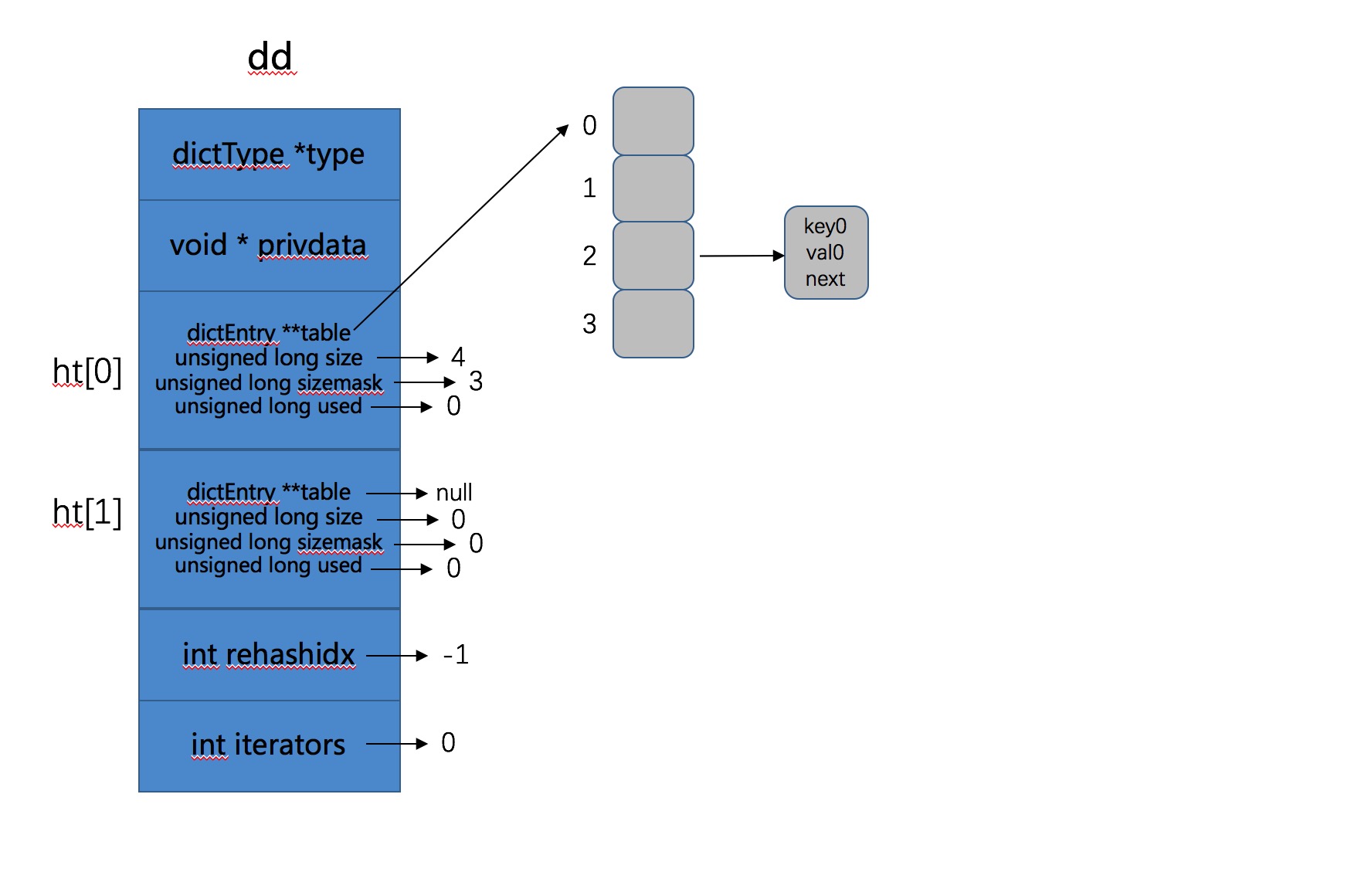
对于我们的代码,走的是 if (d->ht[0].size == 0) return dictExpand(d, DICT_HT_INITIAL_SIZE); 这个分支,也就是会去创建一个 dictht 的 table 大小为 4 的 dict,如下:
int dictExpand(dict *d, unsigned long size)
{
    dictht n; /* the new hash table */
    unsigned long realsize = _dictNextPower(size);

    /* the size is invalid if it is smaller than the number of
     * elements already inside the hash table */
    if (dictIsRehashing(d) || d->ht[0].used > size)
        return DICT_ERR;

    /* Rehashing to the same table size is not useful. */
    if (realsize == d->ht[0].size) return DICT_ERR;

    /* Allocate the new hash table and initialize all pointers to NULL */
    n.size = realsize;
    n.sizemask = realsize-1;
    n.table = zcalloc(realsize*sizeof(dictEntry*));
    n.used = 0;

    /* Is this the first initialization? If so it's not really a rehashing
     * we just set the first hash table so that it can accept keys. */
    if (d->ht[0].table == NULL) {
        d->ht[0] = n;
        return DICT_OK;
    }

    /* Prepare a second hash table for incremental rehashing */
    d->ht[1] = n;
    d->rehashidx = 0;
    return DICT_OK;
}
需要注意的是 _dictNextPower 可以计算出距离 size 最近,且大于或者等于 size 的 2 的次方的值。比如 size 是 4,那距离其最近的值为 4(2 的平方);size 是 6,距离其最近的值为 8(2 的三次方)。然后申请空间,之后判断如果 d->ht[0].table == NULL 也就是我们目前的还未初始化的情况,则初始化 0 号 Hash 表,之后添加相应的元素。我们程序的输出如下所示:
Add ret0 is :0 ,ht[0].used :1, ht[0].size :4, ht[1].used :0, ht[1].size :0如果图示目前的 Hash 表,如下所示:
3. 哈希表扩张
接下来 for 循环继续添加,当 i = 4 时,也就是当添加第 5 个元素时,默认初始化大小为 4 的 Hash 表已经不够用了。此时的 used=4,我们看看扩张操作发生了什么。代码从 _dictExpandIfNeeded(d) 说起,此时满足条件,会执行扩张操作,如下:
if (d->ht[0].used >= d->ht[0].size &&
        (dict_can_resize ||
         d->ht[0].used/d->ht[0].size > dict_force_resize_ratio))
    {
        return dictExpand(d, d->ht[0].used*2);
    }
dictExpand(d, d->ht[0].used*2); 表示重新申请了一个大小为之前 2 倍的 Hash 表,即 1 号 Hash 表。然后将 d->rehashidx = 0; 即表明此时开始 ReHash 操作。
ReHash:就是将原始 Hash 表(0 号 Hash 表)上的 Key 重新按照 Hash 函数计算 Hash 值,存到新的 Hash 表(1 号 Hash 表)的过程。
这一步执行之后此时 Hash 表如下所示:
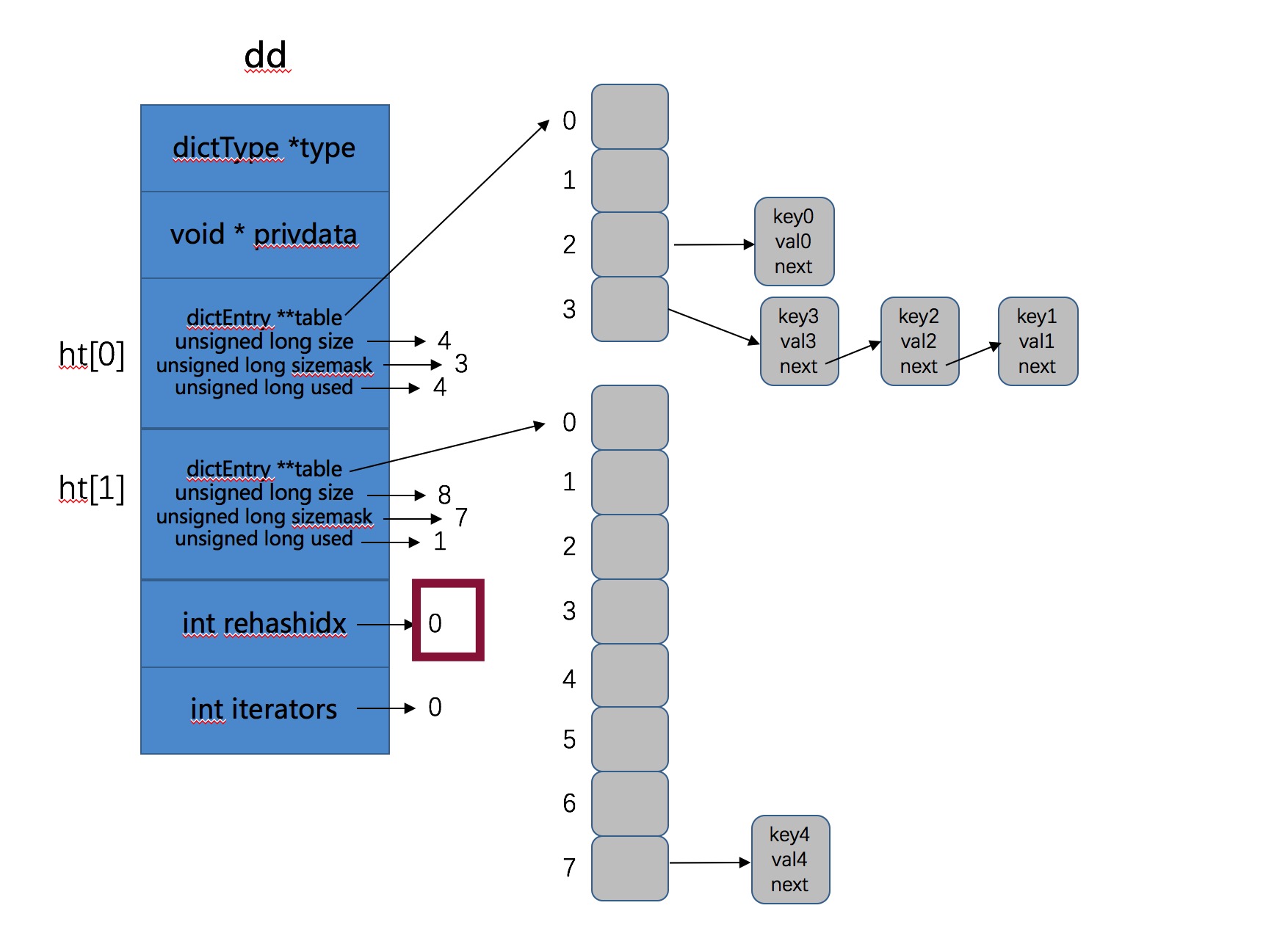
由图可以看到 0 号 Hash 表已经满了,此时我们的新数据被存到了 1 号哈希表中。接下来我们开始了第 6 次循环,继续看在 ReHash 的情况下数据是如何存入的,也就是第 6 次循环,即添加 key5 的过程,继续调用 dictAddRaw 函数:
if (dictIsRehashing(d)) _dictRehashStep(d);此时因为 d->rehashidx = 0,所以会执行渐进式 Hash 操作,即 _dictRehashStep(d):
static void _dictRehashStep(dict *d) {
    if (d->iterators == 0) dictRehash(d,1);  // 如果迭代器是 0,ReHash 步长为 1
}

int dictRehash(dict *d, int n) {
    int empty_visits = n*10; /* Max number of empty buckets to visit. */
    if (!dictIsRehashing(d)) return 0;

    while(n-- && d->ht[0].used != 0) {
        dictEntry *de, *nextde;

        /* Note that rehashidx can't overflow as we are sure there are more
         * elements because ht[0].used != 0 */
        assert(d->ht[0].size > (unsigned long)d->rehashidx);
        while(d->ht[0].table[d->rehashidx] == NULL) {
            d->rehashidx++;
            if (--empty_visits == 0) return 1;
        }
        de = d->ht[0].table[d->rehashidx];
        /* Move all the keys in this bucket from the old to the new hash HT */
        while(de) {
            unsigned int h;

            nextde = de->next;
            /* Get the index in the new hash table */
            h = dictHashKey(d, de->key) & d->ht[1].sizemask;
            de->next = d->ht[1].table[h];
            d->ht[1].table[h] = de;
            d->ht[0].used--;
            d->ht[1].used++;
            de = nextde;
        }
        d->ht[0].table[d->rehashidx] = NULL;
        d->rehashidx++;
    }

    /* Check if we already rehashed the whole table... */
    if (d->ht[0].used == 0) {
        zfree(d->ht[0].table);
        d->ht[0] = d->ht[1];
        _dictReset(&d->ht[1]);
        d->rehashidx = -1;
        return 0;
    }

    /* More to rehash... */
    return 1;
}
int empty_visits = n*10; empty_visits 表示每次最多跳过 10 倍步长的空桶(一个桶就是 ht->table 数组的一个位置),然后当我们找到一个非空的桶时,就将这个桶中所有的 key 全都 ReHash 到 1 号 Hash 表。最后每次都会判断是否将所有的 key 全部 ReHash 了,如果已经全部完成,就释放掉 ht[0],然后将 ht[1] 变成 ht[0]。
也就是此次 dictAdd 操作不仅将 key5 添加进去,还将 0 号 Hash 表中 2 号桶中的 key0 ReHash 到了 1 号 Hash 表上。所以此时的 1 号 Hash 表上有 3 个元素,如下:
Add ret5 is :0 ,ht[0].used :3, ht[0].size :4, ht[1].used :3, ht[1].size :8图示结果如下所示:
4. 删除元素
接下来我们的程序执行了删除操作,dictDelete 函数,实际上调用的是 dictGenericDelete 函数。
static dictEntry *dictGenericDelete(dict *d, const void *key, int nofree) {
    unsigned int h, idx;
    dictEntry *he, *prevHe;
    int table;

    if (d->ht[0].used == 0 && d->ht[1].used == 0) return NULL;

    if (dictIsRehashing(d)) _dictRehashStep(d);
    h = dictHashKey(d, key);

    for (table = 0; table <= 1; table++) {
        idx = h & d->ht[table].sizemask;
        he = d->ht[table].table[idx];
        prevHe = NULL;
        while(he) {
            if (key==he->key || dictCompareKeys(d, key, he->key)) {
                /* Unlink the element from the list */
                if (prevHe)
                    prevHe->next = he->next;
                else
                    d->ht[table].table[idx] = he->next;
                if (!nofree) {
                    dictFreeKey(d, he);
                    dictFreeVal(d, he);
                    zfree(he);
                }
                d->ht[table].used--;
                return he;
            }
            prevHe = he;
            he = he->next;
        }
        if (!dictIsRehashing(d)) break;
    }
    return NULL; /* not found */
}
if (dictIsRehashing(d)) _dictRehashStep(d);实际上也执行了 ReHash 步骤,这次将 0 号哈希表上的剩余 3 个 key 全部 ReHash 到了 1 号哈希表上,这其实就是渐进式 ReHash 了。因为 ReHash 操作不是一次性、集中式完成的,而是多次进行,分散在增删改查中,这就是渐进式 ReHash 的思想。
渐进式 ReHash 是指 ReHash 操作不是一次集中式完成的。对于 Redis 来说,如果 Hash 表的 key 太多,这样可能导致 ReHash 操作需要长时间进行,阻塞服务器,所以 Redis 本身将 ReHash 操作分散在了后续的每次增删改查中。
说到这里,有个问题:虽然渐进式 ReHash 分散了 ReHash 带来的问题,但是带来的问题是对于每次增删改查的时间可能是不稳定的,因为每次增删改查可能就需要带着 ReHash 操作,所以可不可以 fork 一个子进程去做这个事情呢?
- 继续看代码,接下来通过
h = dictHashKey(d, key);计算出index,然后根据有无进行 ReHash 确定遍历 2 个 Hash 表还是一个 Hash 表。因为 ReHash 操作如果在进行的话,key 不确定存在哪个 Hash 表中,没有被 ReHash 的话就在 0 号,否则就在 1 号。 - 这次 Delete 操作成功删除了
key0,而且将 0 号哈希表上的剩余 3 个 key 全部 ReHash 到了 1 号哈希表上,并且因为 ReHash 结束,所以将 1 号 Hash 表变成了 0 号哈希表,如图所示:
- 后续的删除操作清除了所有的 key,然后我们调用了
dictRelease(dd)释放了这个字典。
void dictRelease(dict *d)
{
    _dictClear(d,&d->ht[0],NULL);
    _dictClear(d,&d->ht[1],NULL);
    zfree(d);
}


int _dictClear(dict *d, dictht *ht, void(callback)(void *)) {
    unsigned long i;

    /* Free all the elements */
    for (i = 0; i < ht->size && ht->used > 0; i++) {
        dictEntry *he, *nextHe;

        if (callback && (i & 65535) == 0) callback(d->privdata);

        if ((he = ht->table[i]) == NULL) continue;
        while(he) {
            nextHe = he->next;
            dictFreeKey(d, he);
            dictFreeVal(d, he);
            zfree(he);
            ht->used--;
            he = nextHe;
        }
    }
    /* Free the table and the allocated cache structure */
    zfree(ht->table);
    /* Re-initialize the table */
    _dictReset(ht);
    return DICT_OK; /* never fails */
}
四、ReHash 和渐进式 ReHash
- ReHash:就是将原始 Hash 表(0 号 Hash 表)上的 Key 重新按照 Hash 函数计算 Hash 值,存到新的 Hash 表(1 号 Hash 表)的过程。
- 渐进式 ReHash:是指 ReHash 操作不是一次性、集中式完成的。对于 Redis 来说,如果 Hash 表的 key 太多,这样可能导致 ReHash 操作需要长时间进行,阻塞服务器,所以 Redis 本身将 ReHash 操作分散在了后续的每次增删改查中。
具体情况看上面例子。
五、ReHash 期间访问策略
Redis 中默认有关 Hash 表的访问操作都会先去 0 号哈希表查找,然后根据 是否正在 ReHash 决定是否需要去 1 号 Hash 表中查找,关键代码如下(dict.c->dictFind()):
for (table = 0; table <= 1; table++) {
        idx = h & d->ht[table].sizemask;
        he = d->ht[table].table[idx];
        while(he) {
            if (key==he->key || dictCompareKeys(d, key, he->key))
                return he;
            he = he->next;
        }
        if (!dictIsRehashing(d)) return NULL;   // 根据这一句判断是否需要在 1 号哈希表中查找。
    }
六、遍历
可以使用 dictNext 函数遍历:
dictIterator *i = dictGetIterator(dd);    // 获取迭代器
dictEntry *de;
while ((de = dictNext(i)) != NULL) {      // 只要结尾不为 NULL,就继续遍历
    printf("%s->%s\n",(char*)de->key, (char*)de->v.val);
}
输出示例:
Out >
key3->val3
key2->val2
key1->val1
key5->val5
key0->val0
key4->val4
有关遍历函数 dictScan() 的算法,也是个比较难的话题,有时间再看吧。
七、总结
这篇文章主要分析了 dict 的数据结构、创建、扩容、ReHash、渐进式 ReHash、删除等机制。只是单纯的数据结构的分析,没有和 Redis 一些机制进行结合映射,这方面后续再补充,但是已经是一篇深度好文了。
[完]
说明:本文基于 redis-4.0.1 源码进行分析。Redis 后续版本(如 6.x、7.x)中 dict 实现细节可能有所优化或调整(例如 dictEntry 结构优化等),但核心哈希表与渐进式 ReHash 机制原理基本保持一致。 版权声明:本文为原创文章,版权归 戴老师的博客 所有,转载请联系博主获得授权。
本文地址:https://1diff.fun/archives/redis-yuan-ma-fen-xi-dict.html
如果对本文有什么问题或疑问都可以在评论区留言,我看到后会尽量解答。